
The Fed's Rate Cut: A Calculated Risk or a Leap of Faith into the AI-Fueled...
2025-11-04 4 federal reserve news today
Every so often, you can feel the tectonic plates of the future shifting beneath your feet. It’s not an earthquake, not a sudden jolt, but a deep, resonant hum—the sound of a system deciding which path to take. We all felt it this week. It didn’t come from a lab at MIT or a startup garage in Palo Alto. It came from the marble halls of the Federal Reserve.
Most people see the Fed's announcement of a quarter-point interest rate cut and their eyes glaze over. It’s just numbers, right? A slight tweak to the cost of money. But I see something else entirely. I see the source code of our collective ambition being edited in real-time. This isn’t about the S&P 500 or the Dow Jones; it’s about the cost of a dream. It’s the price tag we, as a society, are willing to put on the future. And right now, the committee of programmers in charge of that code is deeply, profoundly divided on what to write next.
Let’s get the basics out of the way. The Fed’s Open Market Committee lowered its benchmark rate to a range between 3.75% and 4%. This is, on the surface, a move to make money cheaper. It’s a signal to invest, to build, to expand. But that’s where the simple part of the story ends.
Think of the economy not as a spreadsheet, but as a vast, complex engine powering human progress. Interest rates are like the fuel injector. A lower rate is supposed to push more fuel into the engine, making it run faster and hotter—powering the labs, the factories, and the startups that are building what’s next. This is the mechanism that funds the crazy ideas, the moonshots, the research that doesn’t have a guaranteed ROI in the next quarter. It’s the lifeblood for the graduate student with a wild theory about battery chemistry or the small team coding an AI that could revolutionize medicine. This uses the federal funds rate—in simpler terms, it’s the wholesale price of capital that determines how much it costs for a bank, a company, or an entrepreneur to take a risk on tomorrow.
So, a cut should be a moment of pure, unadulterated optimism, right? A collective decision to press the accelerator. But that’s not what happened. Instead, we got a hesitant tap on the pedal accompanied by a nervous glance in the rearview mirror. Fed Chairman Jerome Powell stood at the podium, and with the entire world watching, he didn’t offer a confident roadmap. He revealed a deep schism. "A further reduction... is not a foregone conclusion," he said, a point detailed in the Fed meeting recap: Powell says another rate cut in December 'is not a foregone conclusion'. "Far from it."
When I heard those words, I honestly just sat back in my chair, the hum of my own computer seeming to echo the uncertainty. This wasn't the steady hand of a confident pilot. This was the voice of a committee at a crossroads, a debate that goes far beyond economics. What does it say about our vision for the future when the people in charge of its fuel supply are arguing about whether to turn on the spigot or tighten the valve?
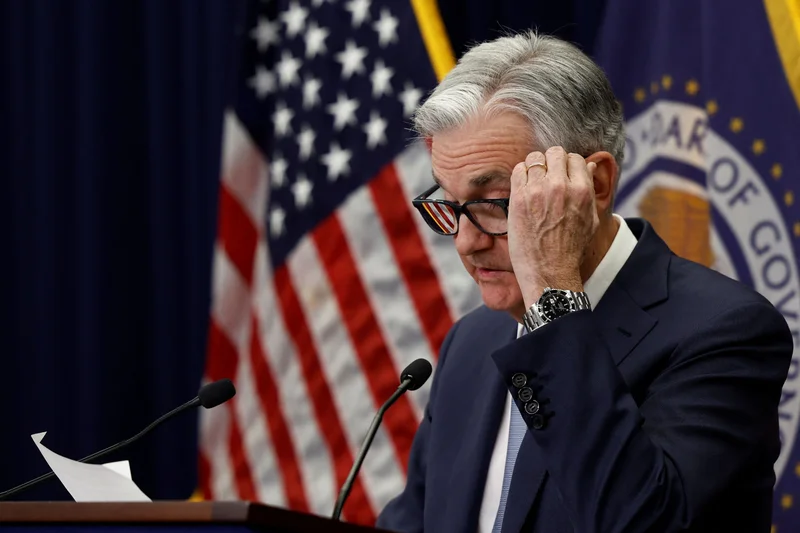
The vote itself tells the whole story: 10-2. This wasn't a consensus; it was a compromise born from conflict. On one side, you have Governor Stephen Miran, who wanted to cut rates even more, to flood the engine with high-octane fuel and see what this machine can really do. On the other, Kansas City's Jeffrey Schmid, who wanted no cut at all, arguing for caution, for stability, for keeping our foot on the brake. And in the middle, Powell, acknowledging a "growing chorus" to just… wait.
This is the kind of breakthrough that reminds me why I got into this field in the first place, because this isn't a financial debate; it's a philosophical one. It's the classic tension between the explorer and the settler, the builder and the steward. Do we risk instability for the chance at exponential progress, or do we prioritize certainty at the cost of groundbreaking innovation? This moment feels like the early days of the internet, when skeptics warned of a bubble while visionaries saw a new world taking shape. We are standing at that kind of precipice right now.
Imagine a world where we choose Miran’s path, where we decide that the greatest risk is not acting, a world where capital flows freely to fund fusion energy, quantum computing, and personalized genetic medicine all at once—the speed of this is just staggering, and it would mean the gap between science fiction and daily reality closes faster than we can even comprehend. That’s what’s on the table. That’s the potential future hanging in the balance of these discussions.
The Nasdaq, filled with the very companies that build that future, seemed to understand this. While the older, more traditional indexes wavered, the Nasdaq rose to a record high. It was a clear, defiant signal from the innovation sector: We’re not waiting for your permission. The future isn’t going to be put on hold. But how much faster could we get there if our foundational economic policy was a tailwind, not a headwind? What marvels are being left on the drawing board because an investor, a VC, or a CEO is spooked by the Fed’s hesitation?
Jerome Powell was right. The path forward is not a foregone conclusion. But he was talking about interest rates, and I’m talking about something much bigger. He was analyzing risk; we should be analyzing opportunity.
The division within the Fed is a perfect mirror of the division in our own hearts. We all crave the safety of the predictable, yet we dream of the magic of the possible. The great leaps in human history have never come from a place of caution. They come from moments of irrational conviction, of bold investment in an uncertain future. They come from deciding that the risk of standing still is far greater than the risk of moving forward.
The Fed’s indecision isn’t a verdict; it’s a question. It’s asking all of us—the builders, the thinkers, the creators—what kind of future we want to build. The market has already started to answer. The real question is, will our institutions have the courage to follow?
Tags: federal reserve news today
Related Articles
The Fed's Rate Cut: A Calculated Risk or a Leap of Faith into the AI-Fueled...
2025-11-04 4 federal reserve news today