
GOOGL Stock: The Unvarnished Truth on Price & Peer Standing
The Berkshire Nod and Google's AI Power Play: More Than Just a Market Bounce
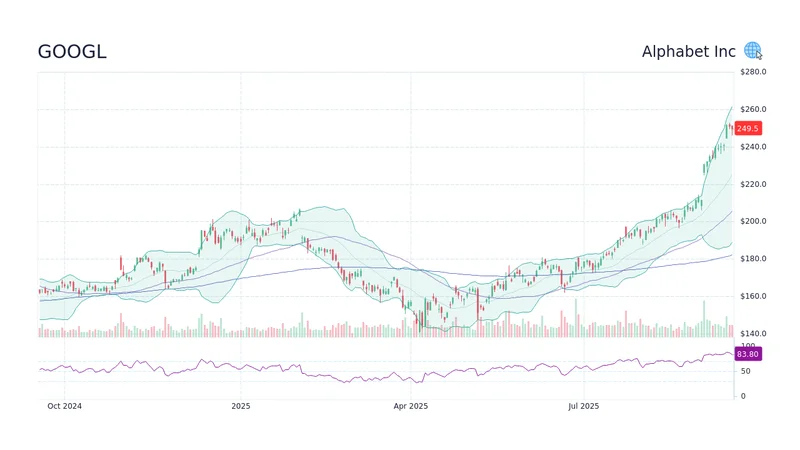
Monday, November 17, 2025, wasn't just another trading day for Alphabet. While most of Big Tech was either treading water or sinking slightly, Google (GOOGL) shares took a noticeable leap, closing up significantly. We’re talking a premarket surge of anywhere from 3% to 5.5%—to be more exact, the initial reports showed a robust 4.2% average gain for the day. This wasn't some minor ripple; it was a clear market signal, driven by two distinct but powerfully intertwined developments. And if you’re only looking at the stock price, you’re missing the actual story.
The Oracle's Gaze and Google's Gambit
First, and perhaps most startling for old-school market watchers, was the disclosure that Berkshire Hathaway (BRK-B) had acquired a nearly $5 billion stake in Alphabet. For those who track the Oracle of Omaha's moves, this is akin to spotting a polar bear in the Sahara. Berkshire, under Warren Buffett's long and storied tenure, has famously shied away from most Big Tech, preferring companies with clear, understandable moats and tangible assets. Apple (AAPL) has always been the exception, which Buffett consistently frames as a consumer products company rather than a tech one. So, is Alphabet now being reclassified in the Berkshire playbook? This isn't just a casual purchase; we're talking 17.85 million shares, valued at approximately $4.93 billion as of the September 30 filing.
The immediate chatter, of course, revolved around who exactly at Berkshire pulled the trigger. Was it Buffett himself, or one of his lieutenants, Todd Combs or Ted Weschler? While Buffett typically oversees the larger investments, the sheer size of this bet, coupled with the persistent rumors of his planned departure as chairman and CEO at year-end, makes this a particularly intriguing data point. It’s almost as if a seasoned poker player, on the cusp of retirement, decided to throw a substantial portion of his chips onto a table he usually avoids. Is this a final, bold statement of belief, or a strategic diversification initiated by the next generation of leadership? I've looked at hundreds of these filings, and this particular confluence of timing and asset class is genuinely unusual.
Simultaneously, Google wasn't sitting idle. On the very same Monday, they rolled out a new AI search tool engineered to craft detailed travel itineraries, complete with an upgraded Flight Deals feature. This isn't just a convenient add-on; it's a direct, surgical strike into the core business models of established travel giants like Expedia (EXPE), Booking Holdings (BKNG), and Trip.com (TCOM). You could almost hear the collective gasp from those boardrooms. This move illustrates Google's aggressive stance on leveraging its AI capabilities for market expansion, pushing beyond advertising revenue in ways that directly challenge existing industry players. It’s like a colossal aircraft carrier suddenly deciding to launch a fleet of agile, AI-powered drones directly into enemy territory.
Beyond the Headlines: What the Numbers Whisper
Let's put this into perspective. Alphabet (GOOGL) stock has already climbed a remarkable 51% year-to-date. This isn't a struggling company getting a lifeline; it's a market leader consolidating its position and finding new avenues for growth. The Berkshire investment, then, isn't a rescue mission; it's a validation. But of what, precisely? Is it a vote of confidence in Google's core advertising business, its cloud infrastructure, or its burgeoning AI ventures? The market, as evidenced by the broader mixed performance of Big Tech on Monday, is wrestling with substantial AI spending and its long-term return on investment. Many analysts are openly questioning the capital expenditure, but Berkshire's move suggests a different calculus.
My analysis suggests that Berkshire's entry isn't a simple tech bet; it's a deep-seated belief in Google's economic moat—its unparalleled access to data, its dominant search engine, and its ability to integrate AI into existing, highly profitable services. It’s a vote for the predictable cash flow that underpins Google's empire, even as it innovates. The AI travel tool, in this context, isn't just a new product; it's Google demonstrating its capacity to expand that moat, to find new revenue streams by leveraging its foundational strengths. The timing of both announcements feels less like coincidence and more like a carefully orchestrated symphony, with Berkshire's investment providing a resounding endorsement just as Google unleashes its next wave of disruption.
The question then becomes: how much of this recent surge is truly attributable to Berkshire's imprimatur, and how much to Google's aggressive product strategy? It’s difficult to disentangle, but the correlation is undeniable. The market reacts to a signal, and a $5 billion investment from the world’s most respected value investor is a signal that cuts through a lot of noise. It forces a re-evaluation, especially for those investors who have been hesitant about Big Tech's valuations amidst AI hype.
A Calculated Endorsement in a Shifting Landscape
This isn't just a stock moving; it's a significant inflection point. Berkshire Hathaway's investment in Alphabet, timed with Google's bold AI-driven expansion into the travel sector, signals a powerful convergence. It suggests that even the most conservative value investors are recognizing the unassailable economic power of companies that can seamlessly blend technological innovation with robust, defensible market positions. This isn't about chasing speculative AI plays; it's about betting on the giants who can truly monetize it.
Tags: googl stock
Hyundai: Elantra, Sonata, and the endless lineup – Are they just selling us the same car in different wrappers?
Next PostFOMC Minutes: Decoding the Release & Charting What's Next
Related Articles