
Rocket Launch Today: The Complete Schedule and How to Watch History Being Made Live
Forget "Launch Day." We've Entered the Age of the Space Highway.
I remember a time, not so long ago, when a rocket launch was a national event. Schools would wheel TVs into classrooms, families would gather, and the world would hold its collective breath for a few fiery, thunderous minutes. It was appointment viewing. A spectacle. Now, living near the Space Coast, the ground trembles with such regularity that it’s become part of the local rhythm, like the tide. The question locals ask has shifted from "is there a rocket launch today?" to "which rocket launch is today?"
This November, Florida’s Space Coast is on the verge of shattering its annual launch record. With 90 launches already logged by the end of October, the record-breaking 94th flight is not a matter of if, but when. The Is there a launch today? Upcoming SpaceX, Blue Origin, ULA launch schedule at Cape Canaveral shows just how packed the manifest is, making it clear this isn't a fluke. This is the new normal. We are witnessing, in real-time, the birth of the space highway—a constant, roaring stream of traffic leaving our planet.
What we're seeing is a fundamental paradigm shift in our relationship with space. It's the difference between building the first transcontinental railroad, a monumental and singular achievement, and operating a modern freight network that moves millions of tons of cargo every single day. One is a historic event; the other is the engine of an economy. We have officially entered the age of the engine.
The New Rhythm of the Cosmos
Take a look at the manifest for just the first part of November. SpaceX has three Falcon 9 missions lined up in less than a week—on the 5th, the 8th, and the 10th. Each one is carrying a batch of Starlink satellites, the building blocks of a global internet constellation. This isn't exploration in the classic sense; this is infrastructure. It's the most ambitious utility project in human history, and SpaceX is rolling it out with the relentless, metronomic efficiency of an assembly line.
The sheer cadence of it all is just staggering—it means the gap between a concept being drawn on a whiteboard and a satellite actually providing service from orbit is shrinking at a rate that is almost hard to process. Think about that. We've gone from decades of planning for a single mission to a reality where a SpaceX rocket launch today is as predictable as a morning commute. This relentless pace, this operational drumbeat, is what's truly revolutionary. It's turning low-Earth orbit from a destination into a domain—a place where we don't just visit, but where we work, build, and connect.
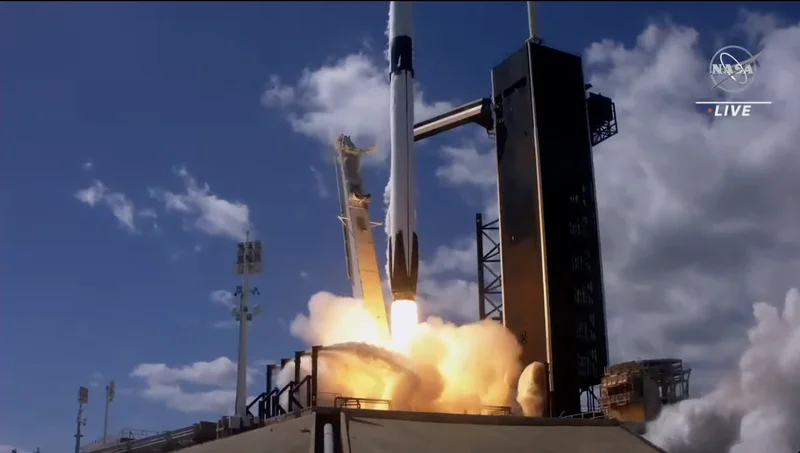
But what does this new rhythm actually enable? It democratizes access. When launch costs plummet and opportunities to get to orbit multiply, it opens the door for smaller companies, universities, and even nations that were previously priced out of the space game. How many brilliant ideas have been stuck on Earth simply because the ride-share to orbit hadn't arrived yet? We're about to find out.
A Diversifying Fleet for a New Frontier
Of course, this isn't just the Elon Musk show. A healthy, robust highway needs more than one kind of vehicle, and that’s exactly what we’re seeing. On the same night as a Starlink launch, the grand old veteran of the industry, United Launch Alliance, is slated to send up its powerful Atlas V. This rocket will be carrying a massive communications satellite for Viasat, a critical piece of hardware for connecting the globe. ULA represents the bedrock of reliability, the heavy-freight hauler that industry has depended on for decades.
But the launch that has me glued to the schedule, the one that truly signals the future, is Blue Origin’s New Glenn. Sometime in early November, this absolute behemoth of a rocket—we’re talking a vehicle designed to compete with the biggest in the world—is set to have its second flight. When I first saw the New Glenn on the manifest carrying a real, high-stakes NASA payload, I honestly just sat back in my chair, speechless. This is the kind of progress that reminds me why I got into this field in the first place.
This isn't just another rocket; it’s a new superhighway on-ramp. And for its second-ever mission, it’s carrying NASA’s twin ESCAPADE spacecraft to Mars to study the planet’s magnetosphere. Let’s break that down. The magnetosphere is essentially the magnetic shield that protects a planet from solar wind—in simpler terms, it's a key ingredient for a planet's ability to hold onto an atmosphere and potentially support life. Sending a science mission to another planet is a huge deal. Entrusting it to the second flight of a brand-new rocket? That’s an almost breathtaking vote of confidence. It shows we're moving past the era of tentative, overly cautious baby steps and into a bolder, more assertive phase of space activity.
This diversification is the critical next step. With SpaceX’s Falcon 9 as the workhorse, ULA’s rockets as the proven heavy-lifters, and now Blue Origin’s New Glenn entering the scene, we’re building a dynamic, competitive, and resilient ecosystem. This isn't just about launching satellites anymore. This is about building the foundation for missions like Artemis II, which will send humans back around the moon, and for innovative vehicles like Sierra Space’s Dream Chaser.
Naturally, with any new and bustling frontier, there come responsibilities. As we fill the orbital highways, we must become better traffic cops. Managing orbital debris and ensuring sustainable practices aren’t just good ideas; they’re essential for making sure this new era has a future. Building a highway is one thing; keeping it open and safe for generations to come is another challenge entirely.
The Sky Is No Longer a Ceiling; It's a Floor
For decades, we looked up at the stars and saw a destination—a distant, almost mythical place you could only reach with staggering effort and national will. But this relentless launch schedule from Cape Canaveral tells a different story. It’s the sound of a new reality being forged, one launch at a time. The sky is no longer the limit. It’s not even a ceiling. It’s becoming a floor—a new foundation from which we will build the next chapter of human civilization. We are not just going to space; we are expanding into it. And it's all happening right now, with a roar that shakes the ground and a fire that lights up the night sky, nearly every single day.
Tags: rocket launch today
SpaceX Launch Today: Confirmed Time, Live Stream Details, and Mission Status
Next PostCZ's Big Aster Buy: Why It Happened and If It's a Trap
Related Articles